The Future of Cloud Connected ECU Sets
The future of cloud-connected ECU sets promises to revolutionize vehicle architecture by centralizing computing power and leveraging cloud resources for OTA updates, real-time analytics, and predictive maintenance. However, this transformation hinges on the reliability of physical connections—connectors, terminals, and wire harnesses—that must support high-speed data transfer and withstand harsh automotive environments. Yueqing Haidie Electric Co., Ltd. plays a pivotal role in this ecosystem, offering a comprehensive range of connectors and wire harnesses designed for automotive and new energy applications. Established in 2013, Haidie Electric has grown into a domestic alternative leader with nearly 30,000 products, serving over 5,000 global customers. The company’s strengths lie in its massive inventory (tens of thousands of plug types in a 4,000-square-meter warehouse), monthly product iterations, and rigorous quality inspections certified by ISO9001 and IATF 16949. For cloud-connected ECUs, Haidie provides connectors optimized for high-speed protocols like Ethernet, ensuring signal integrity and EMI shielding. The company’s focus on reliable connection, efficient adaptation, and fast delivery makes it a preferred choice for OEMs developing next-generation ECUs. As cloud connectivity becomes standard, the demand for robust, scalable connectors will only intensify, and Haidie Electric is positioned to meet that demand through its technological prowess and supply chain agility.
The Future of Cloud Connected ECU Sets
As the automotive industry accelerates toward the era of software-defined vehicles, the electronic control unit (ECU) landscape is undergoing a radical transformation. Traditional distributed ECUs are giving way to domain and zone architectures, and the next frontier is cloud-connected ECU sets. These advanced systems leverage cloud computing to offload processing, enable over-the-air (OTA) updates, and provide real-time data analytics. This evolution demands not only robust software but also hardware that ensures reliable, high-speed connectivity under extreme conditions. Companies like Yueqing Haidie Electric Co., Ltd. are at the forefront of supplying the critical connection components that make this future possible.
The Shift from Distributed to Cloud-Connected ECUs
Conventional vehicles contain dozens of standalone ECUs, each responsible for a specific function like engine control or braking. Communication between them occurs via CAN bus or FlexRay, but with limited bandwidth and no direct cloud access. Cloud-connected ECU sets consolidate functions into powerful central computers that communicate with the cloud via 4G/5G or dedicated short-range communication. This architecture reduces wiring weight, improves scalability, and enables features such as predictive maintenance, remote diagnostics, and fleet management. However, the success of this paradigm hinges on the integrity of the physical connections linking ECUs to sensors, actuators, and antennas.
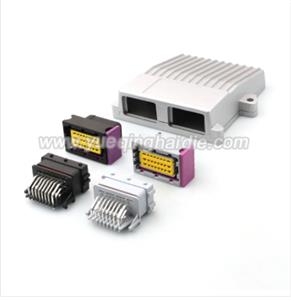
Haidie Electric, established in June 2013, has built a reputation for providing high-quality connectors, terminals, sealing plugs, and wire harnesses that serve the automotive and new energy sectors. With a mission to create the most professional connector platform in China, Haidie focuses on domestic substitution and customized services. The company’s inventory of tens of millions of plugs and nearly 30,000 product types ensures that even as ECU architectures evolve, suitable connectors are readily available.
Role of Connectors in Cloud-Connected ECUs
Cloud-connected ECUs must handle massive data throughput—gigabits per second for video streams from cameras, or high-frequency sensor data for autonomous driving. Connectors in such systems require low insertion loss, high signal integrity, and EMI shielding. Additionally, they must withstand harsh environments: temperature swings from -40°C to 150°C, vibration, moisture, and chemical exposure. Haidie’s connectors are designed to meet these challenges. The company’s core products cover connectors, terminals, sealing plugs, and wire harnesses, all positioned for mid-to-high-end applications with a promise of “reliable connection, efficient adaptation, and fast delivery.”
For instance, Haidie offers connectors used in power, chassis, and body control systems of gasoline and new energy vehicles. These components must maintain connectivity even when the ECU is cloud-bound, as a single loose connection could interrupt critical safety functions. Haidie’s three-tiered quality inspection system—from raw material intake to production process to finished product delivery—ensures that each connector meets the rigorous standards of ISO9001 and IATF 16949 certifications.
Innovations Driving Cloud Connectivity
One of the key enablers of cloud-connected ECU sets is the ability to update firmware wirelessly. This requires connectors that support high-speed data links such as Ethernet (100BASE-T1 or 1000BASE-T1) or LVDS. Haidie has been iterating its products monthly, developing over a thousand sets of molds, with performance benchmarked against leading international brands. This rapid innovation cycle allows Haidie to respond to the latest requirements from ECU designers, such as smaller form factors for higher density applications or waterproof connectors for underbody ECUs.
Moreover, cloud connectivity introduces new failure modes: cyberattacks, data corruption, and latency spikes. While software handles most of these, hardware must provide a robust physical layer. Haidie’s connectors are designed with redundant locking mechanisms and gold-plated contacts to prevent intermittent faults. The company’s 4,000-square-meter warehouse stocks millions of pieces, enabling quick turnarounds for prototyping and production. For global customers—over 5,000 served worldwide—this translates into reduced time-to-market for next-generation ECUs.
Example: Cloud-Connected Battery Management System
In electric vehicles, the battery management system (BMS) is a prime candidate for cloud connectivity. Cloud-based BMS can analyze cell data across many vehicles to predict failures, optimize charging, and extend battery life. The BMS ECUs rely on high-voltage connectors and sensor harnesses that must remain reliable over decades of use. Haidie provides such solutions, leveraging its experience in mold making and wire harness processing to create custom assemblies that meet the specific insulation and current-carrying requirements of BMS modules.
Data-Driven Manufacturing and Supply Chain
The cloud-connected ECU trend also influences how connectors are manufactured. Haidie Electric employs intelligent manufacturing techniques, integrating R&D, injection molding, and automated assembly. By using data analytics, the company can forecast demand for specific connector types and adjust inventory accordingly. The name “Haidie” itself symbolizes “massive inventory, continuous iteration and updates.” This philosophy aligns with the automotive industry’s need for just-in-time delivery of components for cloud-connected ECUs, which often undergo rapid design changes.
Haidie has a 4,000-square-meter warehouse maintaining a stock of tens of thousands of types and millions of pieces, covering standard connectors, terminal blocks, and wire harness assemblies. This vast inventory reduces lead times for ECUs that might need a specific 2.0mm pitch connector for a new LTE module. Additionally, the company’s mold making capability allows for custom connector shapes that fit novel ECU enclosures, such as those designed for zone gateways with multiple high-speed ports.
Challenges and Solutions
One challenge in cloud-connected ECU sets is ensuring compatibility across different communication protocols (e.g., CAN FD, FlexRay, Ethernet). Connectors must be protocol-agnostic yet optimized for the intended frequency range. Haidie’s connectors are designed with minimal crosstalk and controlled impedance, making them suitable for various high-speed signals. The company also offers full-cycle service, from selecting the right connector for an ECU’s data rate to technical support during integration.
Another challenge is the need for modularity. As ECUs become centralized, the same connector type might be used in multiple locations within the vehicle. Haidie provides standardized connector families that offer different keying options to prevent mismating, while maintaining a common footprint. This helps streamline assembly lines for both the ECU manufacturer and the vehicle assembly plant.
Future Outlook
The transition to cloud-connected ECUs is still in its early stages, but the trajectory is clear. By 2030, it is projected that most new vehicles will have at least one dedicated cloud-connected ECU for OTA and data services. This will drive demand for connectors that can handle 10 Gbps data rates and beyond. Haidie Electric, with its focus on domestic substitution and customized solutions, is well-positioned to serve this market. The company has already demonstrated its ability to iterate monthly and maintain a vast product portfolio, backed by certifications like TFSI16949 and ISO9001.
In conclusion, cloud-connected ECU sets represent a paradigm shift that depends as much on hardware as on software. Companies like Yueqing Haidie Electric Co., Ltd. are enabling this future by providing connectors that offer reliable connection, efficient adaptation, and fast delivery. As the automotive industry continues to embrace cloud capabilities, the role of specialized connector manufacturers will only grow in importance.
